
How artificial intelligence is redefining accuracy, compliance, and candidate experience across the background screening industry.
Introduction
The world of hiring has never moved faster. With the future of background checks evolving rapidly, remote work, global recruiting, and complex compliance laws now demand that employers make decisions quickly — but carefully. At the same time, artificial intelligence (AI) has emerged as one of the most transformative forces in business operations. From résumé screening to predictive analytics, AI is changing how companies find, verify, and hire talent.
Now, AI is reshaping one of the most crucial steps in hiring: background checks. Automated data retrieval, intelligent adjudication, and risk-based decision models are replacing slow manual processes with smarter, compliant, and auditable workflows.
For HR leaders and compliance professionals, understanding this shift isn’t optional — it’s essential for staying competitive and legally secure.
1. What Are AI-Driven Background Checks?
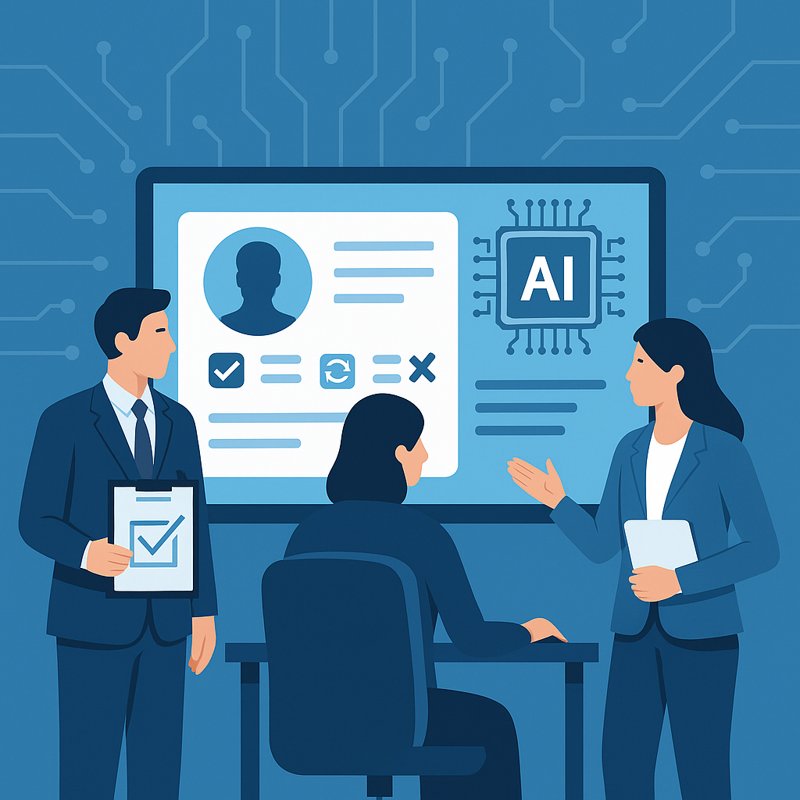
AI-driven background checks use machine learning, natural language processing, and automation to enhance every phase of employment screening. Instead of relying solely on human researchers to pull and interpret records, AI systems can analyze large datasets, identify relevant information, and flag inconsistencies for review.
Key Functions Include:
- Automated Record Retrieval: Integrating directly with court databases and verification APIs to collect results in seconds.
- Data Normalization: AI converts inconsistent formats from thousands of jurisdictions into a standardized report.
- Smart Matching: Algorithms cross-reference identifiers to minimize false positives and missed records.
- Automated Adjudication Support: The system applies employer-defined criteria to categorize results (e.g., “meets,” “review,” “exclude”).
- Continuous Screening Alerts: Ongoing monitoring of licenses or criminal databases after hire.
Example: A national employer can process 1,000 background checks per week with 40% less manual review time using an AI-enabled workflow.
2. How AI Improves Speed and Accuracy
Faster Turnaround Times
Traditional screening requires manual database searches, county-level requests, and human follow-ups. AI automation drastically reduces this cycle, cutting turnaround time (TAT) from days to hours.
Reduced Human Error
Data entry mistakes, inconsistent adjudication, or missed records can lead to compliance risk. AI systems validate identifiers automatically and enforce standardized rules, creating uniformity across departments and locations.
Intelligent Prioritization
AI can triage cases that require immediate attention — for example, applicants flagged under specific regulatory criteria — allowing compliance teams to focus where it matters most.
3. Strengthening Compliance and Governance
Compliance remains the backbone of employment screening. The Fair Credit Reporting Act (FCRA), Equal Employment Opportunity Commission (EEOC) guidance, and a patchwork of state laws impose strict limits on how data can be collected, used, and disclosed.
AI, when deployed responsibly, strengthens compliance rather than threatens it.
Built-in Audit Trails
Every automated decision, data access, or adjudication action is logged and timestamped — a critical safeguard for defending compliance audits.
Automated Notices and Disclosures
AI workflows can automatically trigger pre-adverse and adverse-action notices, ensuring statutory timelines are met.
Policy Enforcement
Rules can be encoded directly into the system. For instance, Philadelphia’s updated “Ban-the-Box” law limits consideration of misdemeanors older than four years — AI ensures those parameters are applied uniformly.
Cross-Reference:
See our companion article, FCRA Compliance in 2025: What Every Employer Must Know, for a detailed breakdown of upcoming regulations.
4. Enhancing the Candidate Experience
Hiring today is as much about experience as evaluation. Candidates expect transparency, communication, and speed.
Mobile-First Interfaces
AI-powered systems offer mobile consent forms, real-time updates, and digital identity verification — reducing friction during onboarding.
Faster Feedback Loops
Because AI shortens turnaround times, recruiters can keep candidates informed and maintain engagement, reducing drop-off rates.
Fairness and Transparency
AI can help standardize decisions, reducing the appearance of bias — but only if employers audit algorithms regularly and ensure human oversight remains part of the process.
5. Real-World Applications of AI in Screening
| Use Case | How AI Helps | Compliance Benefit |
|---|---|---|
| Criminal Records Searches | Automated court-database routing & classification | Faster results, uniform criteria |
| Employment Verifications | Automated outreach and status detection | Reduces manual delays |
| License Monitoring | Continuous credential validation | Real-time alerts |
| Identity Verification | Biometric & document matching | Prevents fraud |
| Risk Pattern Detection | AI models flag anomalies | Early issue identification |
See related: Continuous Background Screening: Is It Right for Your Company?
6. Addressing Bias, Privacy, and Ethical Challenges

AI is not infallible. Poorly designed models can replicate bias or misinterpret data. Employers must implement AI governance frameworks that emphasize fairness, transparency, and accountability.
Best Practices:
- Human-in-the-Loop Review: AI should assist, not replace, human adjudication.
- Dataset Auditing: Regularly review training data for demographic bias.
- Transparency: Disclose to candidates when AI tools are used in decision-making.
- Data Minimization: Retain only the information necessary for lawful employment purposes.
- Third-Party Oversight: Evaluate vendors for algorithmic fairness certifications and security standards (e.g., SOC 2 Type II).
Data Privacy
AI systems must comply with FCRA, GDPR (for global applicants), and state privacy laws like CCPA/CPRA. Encryption, access control, and anonymization are non-negotiable.
7. Implementation Roadmap
Transitioning to AI-enabled screening doesn’t have to be overwhelming.
- Define Risk Tiers: Map screening packages by job level, role sensitivity, and jurisdiction.
- Assess Your Current Process: Identify bottlenecks in verification, adjudication, or compliance steps.
- Choose the Right Technology Partner: Evaluate vendors based on accuracy, uptime, data sources, and legal support.
- Pilot Program: Start with a small region or department to benchmark performance and compliance metrics.
- Train HR Teams: Provide education on FCRA obligations, data handling, and responsible AI use.
- Monitor & Audit Quarterly: Review disputes, false positives, and feedback from both recruiters and candidates.
8. Metrics to Measure Success
| Metric | Description | Target Outcome |
|---|---|---|
| Turnaround Time (TAT) | Avg. time per background check | ↓ 30–50% |
| Dispute Rate | % of candidates contesting results | ↓ 20% |
| Candidate Satisfaction (NPS) | Survey score post-screening | ↑ Positive |
| Compliance Exceptions | Missed notice or timeline errors | ↓ Near zero |
| Recruiter Efficiency | Hours saved per case | ↑ Productivity |
Tracking these metrics helps prove ROI while maintaining compliance integrity.
9. The Future: Predictive & Continuous Screening
AI’s next evolution lies in predictive analytics and continuous screening. Predictive models will assess contextual risk indicators — for example, patterns in public data that may suggest credential lapses or fraud risk — before they impact an organization.
Continuous screening, already gaining traction, ensures employers stay informed of post-hire issues while respecting privacy and due process.
As these innovations mature, the role of HR will shift from reactive record checking to proactive risk management.
10. Conclusion: Building Trust Through Responsible AI
AI is transforming background screening from a slow, paper-based necessity into a strategic advantage. But the key isn’t automation — it’s responsible automation. Employers that balance technology with compliance, ethics, and human oversight will gain faster hires, reduced risk, and stronger reputations.
As regulatory scrutiny increases, partnering with an experienced, FCRA-compliant provider ensures that AI tools are deployed legally and effectively.
Contact The Screening Source
For compliant, nationwide background screening powered by accuracy and innovation, contact:
📧 info@thescreeningsource.com
☎️ 860-591-5225
🌐 https://thescreeningsource.com
